Accessibility Is Inclusion You Can See and Touch
Here is a number that should stop every leader in their tracks: 1 in 4 adults in the United States has a disability. That is approximately 61 million people — colleagues, customers, community members, and candidates — navigating a world that was largely designed without them in mind. And yet, when most organizations talk about diversity and inclusion, accessibility rarely leads the conversation. It shows up as a footnote, a compliance checkbox, or a facilities issue delegated to someone who has never read a single page of inclusion strategy.
That is a problem. Not just an ethical one — though it absolutely is that — but a strategic one. When your physical workspace is difficult to navigate and your digital presence fails basic accessibility standards, you are not just falling short on inclusion. You are leaving talent on the table, turning away customers, and signaling to the world that your commitment to inclusion is more performative than real.
I have spent years working with organizations on their inclusion journeys, and one of the most consistent gaps I see is the disconnect between what organizations say about inclusion and what their spaces — physical and digital — actually communicate. In The Inclusion Solution, I make the case that true inclusion requires building environments where every person can fully participate, contribute, and thrive. Accessibility is not a separate conversation from inclusion. It is inclusion — the most tangible, visible, and measurable expression of whether an organization means what it says.
The Compliance Trap: Why the ADA Is the Floor, Not the Ceiling
Let me be direct about something. The Americans with Disabilities Act was signed into law in 1990. More than three decades later, organizations are still treating ADA compliance as the finish line rather than the starting point. Compliance means you have met the legal minimum. It does not mean you have created an accessible, welcoming, or genuinely inclusive environment.
The most forward-thinking organizations I have worked with understand that universal design is the real standard to pursue. Universal design is the practice of creating spaces, products, and systems that work for the widest possible range of people — regardless of age, ability, or circumstance. And here is what makes it so powerful: when you design for accessibility, you almost always improve the experience for everyone.
This is what researchers call the "curb cut effect." Curb cuts — those small ramps built into sidewalk edges — were originally mandated for wheelchair users. But walk through any city today and notice who else uses them: parents with strollers, delivery workers with hand trucks, cyclists, travelers with rolling luggage, elderly pedestrians with balance challenges. The accommodation designed for one group created a better experience for everyone. That is not a coincidence. That is what good, inclusive design does.
Adjustable-height desks benefit employees with mobility impairments — and also benefit taller employees, pregnant employees, and anyone who wants to alternate between sitting and standing. Varied lighting options support employees with visual sensitivities — and also reduce eye strain for everyone working long hours. Quiet focus spaces support employees with sensory processing differences — and also give every employee a place to do deep work without distraction. Accessibility and excellence are not in tension. They reinforce each other.
Physical Accessibility: What to Look For Beyond the Ramp
In Diversity & Inclusion: The Big Six Formula for Success, I identify the environment as one of the six critical pillars of an effective inclusion strategy. The environment pillar is not just about culture — it is about the literal, physical conditions in which people work. You cannot achieve workforce excellence if talented people cannot access your workspace in the first place.
Physical accessibility goes well beyond whether you have a ramp at the front entrance. It includes:
- Entrance and navigation: Are all entrances — not just one designated "accessible" entrance — usable by people with mobility aids? Is wayfinding clear, with signage at appropriate heights and in multiple formats?
- Restroom access: Are accessible restrooms available on every floor, not just in one corner of the building?
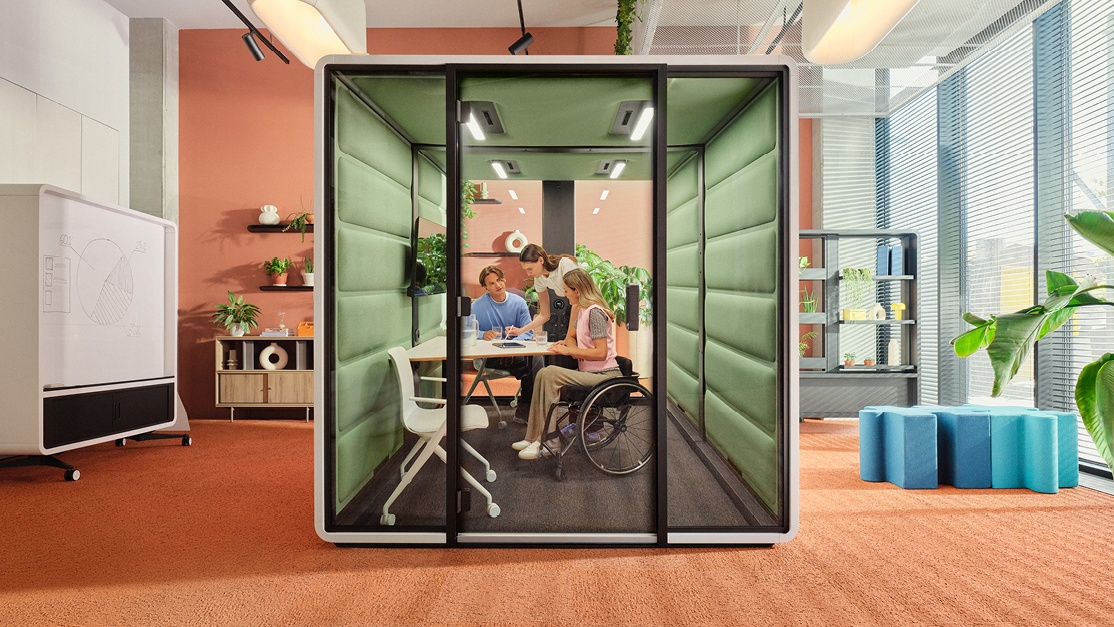
- Meeting room setup: Can someone using a wheelchair sit at the table — not at the end of the table, but at the table, as a full participant? Is there adequate turning radius in the room?
- Sensory considerations: Are there options for employees who are sensitive to fluorescent lighting, strong scents, or high-noise environments?
- Emergency procedures: Does your emergency evacuation plan account for employees with disabilities? Do you have designated evacuation assistants and refuge areas?
That last point is one I want to emphasize because it is consistently overlooked. An organization that has a beautiful accessible entrance but no plan for how an employee who uses a wheelchair evacuates safely in an emergency has not actually thought this through. Accessibility planning must be comprehensive, not cosmetic.
Digital Accessibility: The Invisible Barrier Most Organizations Ignore
If physical accessibility is the issue organizations underinvest in, digital accessibility is the one they barely think about at all. And in a world where work, commerce, and communication happen increasingly online, that is an enormous gap.
The Web Content Accessibility Guidelines — known as WCAG — are the internationally recognized standards for digital accessibility. They cover four core principles: content must be perceivable, operable, understandable, and robust. In practice, that translates to requirements like:
- Alt text for images: Every meaningful image on your website or in your documents should have descriptive alternative text so that screen readers can communicate the content to users who are blind or have low vision.
- Color contrast: Text must have sufficient contrast against its background to be readable by people with low vision or color blindness.
- Keyboard navigation: Every function on your website should be operable without a mouse, because many users with motor disabilities navigate exclusively via keyboard.
- Captioned video: Every video you publish — whether on your external website, your internal learning platform, or your social media channels — should have accurate captions. This serves Deaf and hard-of-hearing users, and also anyone watching in a sound-sensitive environment.
- Screen reader compatibility: Your website's underlying code should be structured so that screen readers can interpret and communicate it accurately.
- Accessible document formats: PDFs and other documents should be formatted and tagged for accessibility, not just visually designed and exported.
Here is the business reality: accessibility failures are not just an inclusion problem — they are a legal and financial risk. Web accessibility lawsuits have increased dramatically over the past several years, with thousands of cases filed annually under the ADA. Organizations with inaccessible websites have faced significant settlements and reputational damage. And beyond legal risk, an inaccessible website is simply a less functional website — for everyone. Accessible code is cleaner code. Accessible design is clearer design. And search engines reward accessible websites with better rankings because the same structural qualities that help screen readers also help search engine crawlers.
The Accessibility Audit Framework: A 10-Point Checklist
One of the most practical things I can offer any leader reading this is a starting point for assessment. You cannot fix what you have not measured. Here is a 10-point accessibility audit framework covering both physical and digital dimensions:
Physical Accessibility
- Entrance access: Are all primary entrances accessible, with automatic doors or easy-open mechanisms and no barriers to entry?
- Restroom access: Are accessible restrooms available on every occupied floor, with adequate space, grab bars, and accessible fixtures?
- Meeting room setup: Can employees using mobility aids participate fully at meeting tables, with adequate clearance and turning space?
- Signage and wayfinding: Is signage in Braille and large print where required? Is wayfinding clear for people with visual or cognitive differences?
- Emergency procedures: Does your emergency plan include specific, documented protocols for employees with disabilities, including designated assistants and refuge areas?
Digital Accessibility
- Website compliance: Has your external website been audited against WCAG 2.1 AA standards? Are identified issues being actively remediated?
- Internal tools accessibility: Are the digital tools your employees use daily — HR platforms, project management software, communication tools — accessible to users with disabilities?
- Document formats: Are documents published internally and externally formatted and tagged for screen reader compatibility?
- Video captioning: Are all video assets — training videos, recorded meetings, marketing content — accurately captioned?
- Assistive technology support: Does your IT infrastructure support the use of assistive technologies, including screen readers, voice recognition software, and alternative input devices?
Use this framework as a starting point, not an endpoint. Conduct the audit, document the gaps, prioritize remediation, and build accessibility into your ongoing quality standards — not as a one-time project, but as a permanent practice.
The Culture Dimension: Accessibility Is Also a Mindset
I want to be clear about something that often gets lost in the technical discussion of ramps and WCAG standards: accessibility is not just about physical and digital infrastructure. It is about culture.
An organization can have a perfectly compliant building and a fully accessible website and still create an environment where employees with disabilities feel they cannot disclose their needs, cannot request accommodations without fear of judgment, and cannot bring their full selves to work. That is not an accessible organization. That is an organization that has done the minimum paperwork.
True accessibility culture means:
- Normalizing accommodation requests. Accommodation should be treated as a standard workplace practice, not an exception that requires an employee to justify their existence. When leaders model this — by talking openly about their own needs, by making accommodation requests easy and confidential, by responding quickly and without stigma — it changes the culture.
- Training managers on disability inclusion. Managers are the frontline of the employee experience. They need to understand their legal obligations under the ADA, but more importantly, they need to understand how to have supportive, non-intrusive conversations with employees about what they need to do their best work.
- Creating psychological safety for disclosure. Research consistently shows that a significant percentage of employees with disabilities do not disclose to their employers — often because they fear being seen as less capable or being passed over for opportunities. Psychological safety around disability disclosure is not automatic. It is built through consistent, visible leadership behavior over time.
In Make It Happen, I write about the importance of creating environments where people can bring their full professional identity to their career. That principle applies directly here. When employees with disabilities feel safe, supported, and fully accommodated, they bring more of their talent, creativity, and commitment to the work. That is not charity. That is competitive advantage.
Accessibility as Innovation Engine
Here is something I find genuinely fascinating, and I share it with every leadership team I work with: some of the most important technological innovations of the past several decades originated from accessibility research.
Voice recognition technology was developed largely to help people with physical disabilities interact with computers. Text-to-speech was created for users who are blind. Autocomplete and predictive text were designed to support users with motor impairments who found typing laborious. Email itself was championed in part because of its utility for Deaf users who needed an alternative to phone communication. The closed captioning technology that powers every streaming platform today was developed for Deaf and hard-of-hearing television viewers.
In every one of these cases, solving for the needs of people with disabilities produced innovations that transformed the experience for everyone. This is not coincidence. Designing for constraint forces creativity. When you commit to making something work for the full range of human ability, you build something better — more flexible, more intuitive, more resilient. Accessibility is not a limitation on innovation. It is one of its most reliable catalysts.
The Business Case Is Not Complicated
For leaders who need the numbers, here they are: the disability community in the United States represents approximately $490 billion in disposable income. Globally, the figure is estimated at over $1 trillion when extended family members are included — what researchers call the "disability market," which includes the significant purchasing influence of family members who make decisions based on whether organizations are accessible and welcoming to their loved ones.
Accessible organizations access this market. Inaccessible organizations do not. It is that straightforward.
And beyond the direct consumer opportunity, consider the talent equation. With 1 in 4 adults having a disability, any organization that creates barriers to employment — whether through inaccessible facilities, inaccessible digital tools, or cultures that make disclosure feel risky — is voluntarily narrowing its talent pool. In a competitive labor market, that is a strategic liability that no organization can afford to ignore.
The data here aligns with everything I have seen in practice. Organizations that invest seriously in accessibility — not just compliance, but genuine, comprehensive, culturally embedded accessibility — perform better on employee engagement, retention, customer satisfaction, and innovation metrics. Inclusion is not a cost center. It is a performance driver.
Design It In From the Start
The most important shift in mindset I want to leave you with is this: the most inclusive organizations do not retrofit accessibility. They design it in from the start.
Retrofitting is expensive, imperfect, and sends a message — whether you intend it or not — that certain people were not part of the original vision. When accessibility is an afterthought, it shows. The ramp bolted onto the side of a beautiful historic building. The "accessible" entrance around back, past the loading dock. The website redesign that launched without any accessibility testing. The training video library with no captions. These are not just operational failures. They are cultural signals.
When you build accessibility into your design process from the beginning — when architects and web developers and HR policy writers and learning designers all operate with accessibility as a baseline requirement, not an optional add-on — you build something fundamentally different. You build an organization that is genuinely designed for everyone.
That is the vision I hold for every organization I work with: not an organization that tolerates disability, accommodates it reluctantly, or checks the compliance box and moves on — but an organization that actively designs for the full range of human experience, because it understands that is where excellence lives.
Accessibility is inclusion you can see, touch, navigate, and experience. It is the most honest answer to the question every employee and customer is quietly asking: Was I part of the design?
Make sure your answer is yes.